
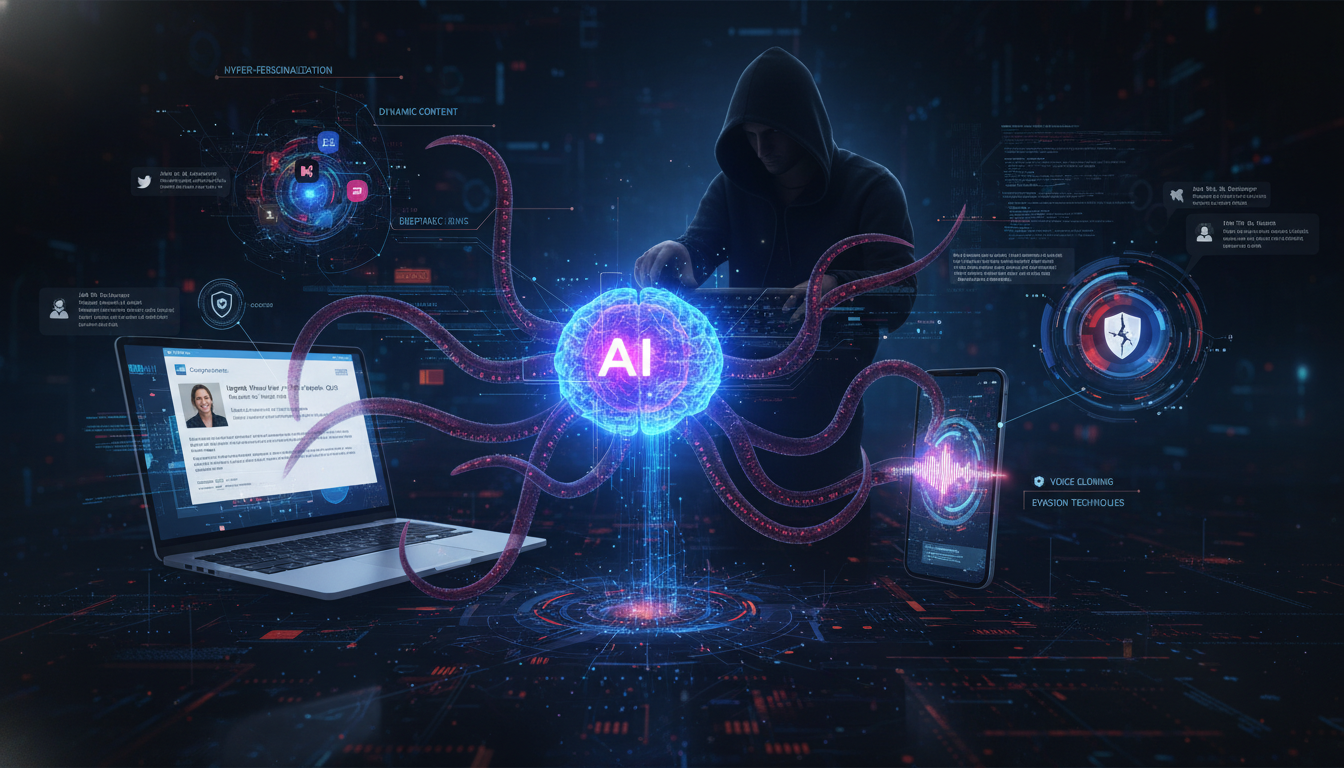
Phishing campaigns are rapidly evolving by integrating AI-driven techniques that make them smarter, more personalized, and harder to detect. These modern phishing attacks leverage machine learning, generative models, and deepfakes to craft convincing emails, voice messages, and even video calls. As a result, users and organizations face escalating risks that demand advanced, multi-layered defense strategies.
The Rise of AI-Enhanced Phishing Techniques
AI has transformed phishing from blunt spam to precision strikes. Instead of generic messages, attackers now deploy hyper-personalized phishing campaigns that mimic tone, style, and even calendar references of specific individuals, dramatically increasing the likelihood of success . In spear-phishing experiments, AI-generated attacks outperformed human-crafted ones—achieving a 24% higher click-through rate by early 2025 . A broader survey reveals that over 82% of phishing emails analyzed between late 2024 and early 2025 contained AI elements, underscoring the technology’s widespread adoption .
Tools and Tactics: From Deepfakes to Automation
Deepfake-Assisted Deception
AI-powered phishing isn’t just about text—it now includes deepfake audio and video, enabling attackers to impersonate executives in convincing calls or messages . Vishing, or voice phishing, is growing too; deepfake attacks have surged, with some studies reporting a 66% increase and average losses around $17,000 per incident .
Automated Reconnaissance and Delivery
AI tools now scan targets at scale, performing reconnaissance at thousands of scans per second and gathering data from social platforms to tailor attacks . Phishing campaigns have become multi-stage: initial harmless messages segue into realistic follow-ups, mimicking actual workflows and leveraging context for believability .
Phishing-as-a-Service (PhaaS) Evolution
Phishing is becoming commoditized. Underground markets now offer subscription-based phishing kits that enable low-skilled actors to deploy sophisticated scams. These services often include personalization engines, obfuscation tools, and even voice deepfakes .
The Scale and Impact of AI-Driven Phishing
AI enhances phishing’s reach and effectiveness. Some observations:
- Click-through rates for AI-powered phishing may reach 54%, compared to around 12% for standard methods—showcasing a 4.5x improvement .
- Global markets in AI-based criminal tools are now worth billions, with underground ecosystems mirroring legitimate SaaS models .
- Phishing via compromised or impersonated business brand domains is rising, particularly around large events like Black Friday, with attackers deploying pixel-perfect fake sites .
- Certain regions report that AI features in roughly 80% of phishing campaigns, contributing to massive financial losses and outlining the convergence of AI with cybercrime .
Human Vulnerabilities and Detection Challenges
Humans remain a critical weak link. A global study revealed that only about 46% of people correctly identified AI-generated phishing emails; less than 30% recognized genuine emails . Notably, this inability to differentiate spanned all age groups.
Experts warn that attackers will increasingly exploit this gap through emotional and psychological manipulation—what’s being termed “emotion-engineered exploitation” .
Defending Against AI-Driven Phishing: Innovations and Strategies
AI-Powered Detection Tools
Organizations have responded with AI-driven defenses. These tools analyze linguistic patterns, user behavior, and communication context to detect anomalies across email, chat, and collaboration platforms . Transformer-based models enhanced with adversarial training and explainability methods are also improving detection of AI-generated phishing threats .
Adaptive Learning and Cognitive Agents
EvoMail, a self-evolving defense framework, uses a red-team/blue-team loop: AI-generated phishing tactics are simulated, then defenses learn, adapt, and improve over time . Meanwhile, personal AI assistants like Cyri help users identify phishing threats through local semantic analysis, supporting both expert and non-expert users .
Best Practices
- Adopt phishing-resistant MFA methods such as FIDO2 keys to reduce credential theft risk .
- Train employees continuously, with simulations emphasizing AI-generated phishing nuances and emotional manipulation tactics.
- Monitor for unauthorized or “shadow AI” agents within organizations, which expand the attack surface .
- Implement Zero Trust browser isolation and real-time traffic inspection to intercept phishing attempts cloaked in CAPTCHAs or fileless code .
Conclusion
AI is not just an attacker’s tool—it’s reshaping the entire phishing ecosystem. From hyper-personalized spear phishing to deepfake-enabled vishing and commoditized attack platforms, phishing campaigns are now more scalable, credible, and emotionally manipulative than ever. At the same time, AI defenses are rising to meet the challenge, employing sophisticated detection, behavioral analysis, and adaptive learning.
Staying ahead requires both investing in advanced technologies and elevating human awareness. Organizations and individuals must treat phishing not as an outdated nuisance but as a dynamic, AI-empowered threat demanding proactive, layered defenses.
FAQs
What makes AI-driven phishing more dangerous than traditional phishing?
AI enables personalization at scale—messages are tailored to mimic known contacts or projects, making detection harder. Deepfake elements and multi-stage campaigns add urgency and credibility that generic phishing lacks.
Can AI be used to defend against AI-powered phishing?
Absolutely. AI-based detection systems analyze tone, intent, and anomalies across communication channels. Solutions like cognitive agents and adversarial training models continuously adapt to evolving threats.
How effective are deepfake phishing attacks?
Deepfake phishing—whether by audio or video—is growing fast and can bypass logical defenses by leveraging emotional trust. Vishing attacks have spiked significantly, costing victims thousands on average and exploiting human trust in voice authenticity.
What should organizations do to protect users?
Implement phishing-resistant MFA, enforce Zero Trust and behavioral monitoring, run AI-specific phishing simulations, and monitor for unauthorized AI use internally. Transparency and training help reduce human error.
Is phishing-as-a-service a real threat?
Yes. Underground markets offer phishing kits and deepfake tools as subscription services. This democratizes access to advanced phishing capabilities, making even unsophisticated actors a threat.
How can individuals identify AI-generated phishing attempts?
Look for emotionally manipulative language, unexpected requests, or overly polished, friendly messages. Use direct verification methods—like calling known contacts—and avoid trusting unsolicited links or attachments—even if they seem personalized.