
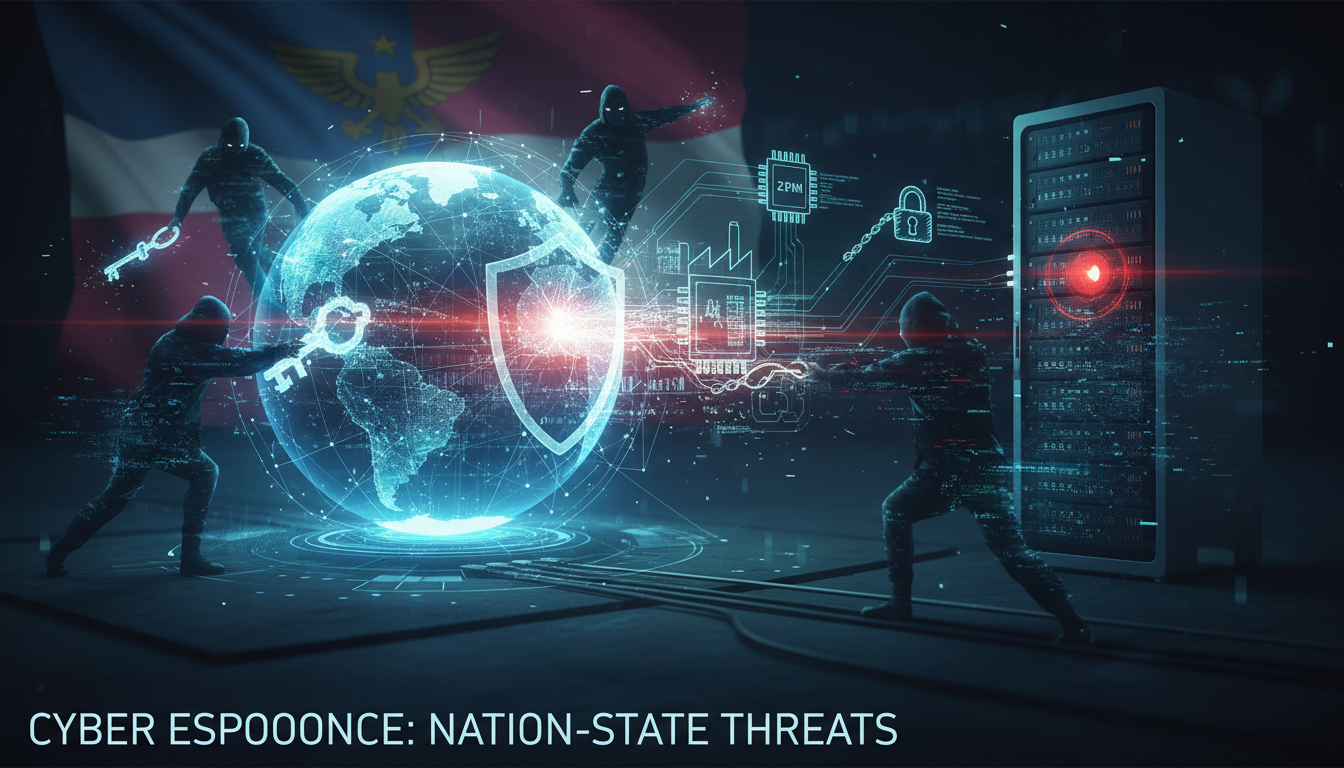
Cyber espionage linked to nation-state actors refers to covert digital operations conducted or supported by governments aiming to infiltrate or surveil targets—such as governments, businesses, or infrastructure—for strategic or political gain. These threats are diverse, evolving rapidly, and they pose serious risks to national security and global stability. Let’s dive into the threats and impacts of state-backed cyber espionage through real-world examples and evolving tactics.
Rising Landscape of State-Sponsored Cyber Espionage
Cyber espionage by state actors has surged in complexity and scope, with key players wielding advanced tools to infiltrate systems across borders. Russia, China, Iran, and North Korea remain the most active, driving a significant share of known international operations—together responsible for roughly three-quarters of all reported state-linked cyber activity .
China and Telecommunications: Salt Typhoon and Volt Typhoon
In late 2024 and into 2025, the Salt Typhoon campaign—tied to China’s Ministry of State Security—compromised at least nine U.S. telecom firms. Attackers accessed critical routing infrastructure, surveillance metadata, and law enforcement call data, affecting over a million individuals, including high-profile political targets .
Simultaneously, Volt Typhoon, believed to be linked to the Chinese military, targeted U.S. critical infrastructure with stealth tactics—preparing for possible sabotage of communications during geopolitical crises .
Escalating Russian Cyber Espionage
Microsoft reports a 25% rise in Russian cyberattacks against NATO countries over the past year—particularly targeting government, research, and NGO sectors . These attacks are increasingly entwined with disinformation and hybrid warfare efforts that blur the line between digital intrusion and military conflict .
Russian groups like Star Blizzard (also known as Callisto Group) have endured sanctions as they carry out long-term espionage against lawmakers, defense actors, and journalists in the U.S. and Europe—most notably using spear-phishing campaigns and proxy infrastructure .
North Korea’s Remote Worker Schemes
North Korea has cleverly exploited remote work, funneling stolen identities and fake IT roles into Western companies. These operations—run by Department 53—employ thousands and are known to generate significant illicit revenue. One case alone generated over $17 million via a laptop farm facilitating North Korean operatives . The operation enables data theft, malware deployment, and sanctions evasion—all supporting North Korea’s weapons programs .
AI and Evolving Cyber Tactics
In 2025, a surge in AI-driven espionage and disinformation was observed. Nations like Russia, China, Iran, and North Korea doubled down on AI-generated fake content, automated phishing, and impersonations . Another example saw Chinese phishers impersonating U.S. policy briefings to dupe diplomats—detected by AI-based cybersecurity tools .
Methodologies and Strategic Implications
Advanced Persistent Threats and Zero-Day Exploits
State actors typically deploy APT (Advanced Persistent Threat) tactics requiring stealth and patience. For instance, Chinese actors used zero-day vulnerabilities in Fortinet and Ivanti products to infiltrate critical systems without detection . These methods underscore how defensive gaps in VPNs, routers, or trusted IT products can compromise national infrastructure.
Living-Off-the-Land and Social Engineering
Sophisticated espionage campaigns increasingly rely on “living-off-the-land” tactics—exploiting legitimate tools and credentials for persistence (e.g., SSL VPN backdoors) . Meanwhile, social engineering remains central: Iranian groups impersonate journalists or NGOs to bait credentials, while North Korea infiltrates organizations through remote jobs .
Geopolitical Targeting and Sector Focus
Attacks often correlate with geopolitical tensions. Chinese campaigns focus on Southeast Asia, Taiwan, and media or telecom sectors . Russian espionage ratcheted up around NATO and Ukraine . Iran’s focus shifted to Israel and Gulf allies post-2023 escalation . North Korea continues exploiting remote-work vulnerabilities broadly .
Real-World Impact and Consequences
National Security Threats and Information Leaks
Infiltration of U.S. treasury and telecom systems by Salt Typhoon could impact surveillance and law enforcement ability—potentially exposing state secrets or undermining intelligence credibility .
Economic and Policy Disruptions
Such campaigns often target data tied to trade policy, rare-earths industries, or diplomatic communications, creating economic leverage .
Erosion of Trust and Infrastructure Resilience
AI-facilitated phishing, deepfakes, or impersonation campaigns (like Mustang Panda’s policy briefing fraud) erode trust in official communication channels . Meanwhile, artificial intelligence vulnerabilities in datacenters raise concerns about sabotage or IP theft in AI sectors .
Expert Perspective
“State-backed cyber espionage is no longer a future threat—it’s embedded in global geopolitics, exploiting both technology gaps and human vulnerabilities to achieve strategic objectives.”
This underscores the urgent need for integrated cybersecurity strategies that balance human training, robust infrastructure, and threat intelligence sharing.
Conclusion
Nation-state cyber espionage increasingly defines modern geopolitical conflict, with China, Russia, Iran, and North Korea employing AI, zero-days, impersonation, and remote infiltration to penetrate sectors from telecom and government to critical infrastructure. These threats evolve along with global tensions, bringing serious implications for national security, trust, and economic resilience. Defensive strategies must evolve accordingly: by strengthening digital infrastructure, monitoring AI risks, securing remote-hiring practices, and fostering cross-border collaboration.
FAQs
What distinguishes nation-state cyber espionage from other cyberattacks?
Nation-state espionage typically involves long-term, coordinated operations backed by government resources. It targets sensitive systems—like defense, communications infrastructure, or policy data—for strategic gain rather than immediate financial return.
Which countries are most involved in cyber espionage?
China, Russia, Iran, and North Korea account for the majority of reported operations, using APTs, remote infiltration, and AI to target foreign governments, industries, and infrastructure .
How are AI and phishing tactics advancing cyber espionage?
AI tools now enable creation of sophisticated fake content and personalized phishing campaigns. Cybercriminals are using AI to mask identities, impersonate officials, and automate infiltration. Detection, in turn, often employs AI-based cybersecurity systems .
Why are telecom systems a major target?
Telecom systems handle vast troves of metadata and call tracking—critical for intelligence operations. Breaches, like Salt Typhoon’s, allow actors to access surveillance metadata and tracking infrastructure, enabling wide-scale espionage .
How can organizations defend against state-backed espionage?
Strategies include patching known vulnerabilities quickly, training staff against phishing and impersonation, securing remote work hiring practices, investing in AI-aware defenses, and collaborating globally across industries and governments.
What role do remote worker schemes play in espionage?
Remote worker impersonation—like North Korea’s laptop farm operations—provides insider access to companies. These workers may carry malware, steal IP, or exfiltrate data while flying under the radar, making traditional perimeter defenses less effective.