

Introduction
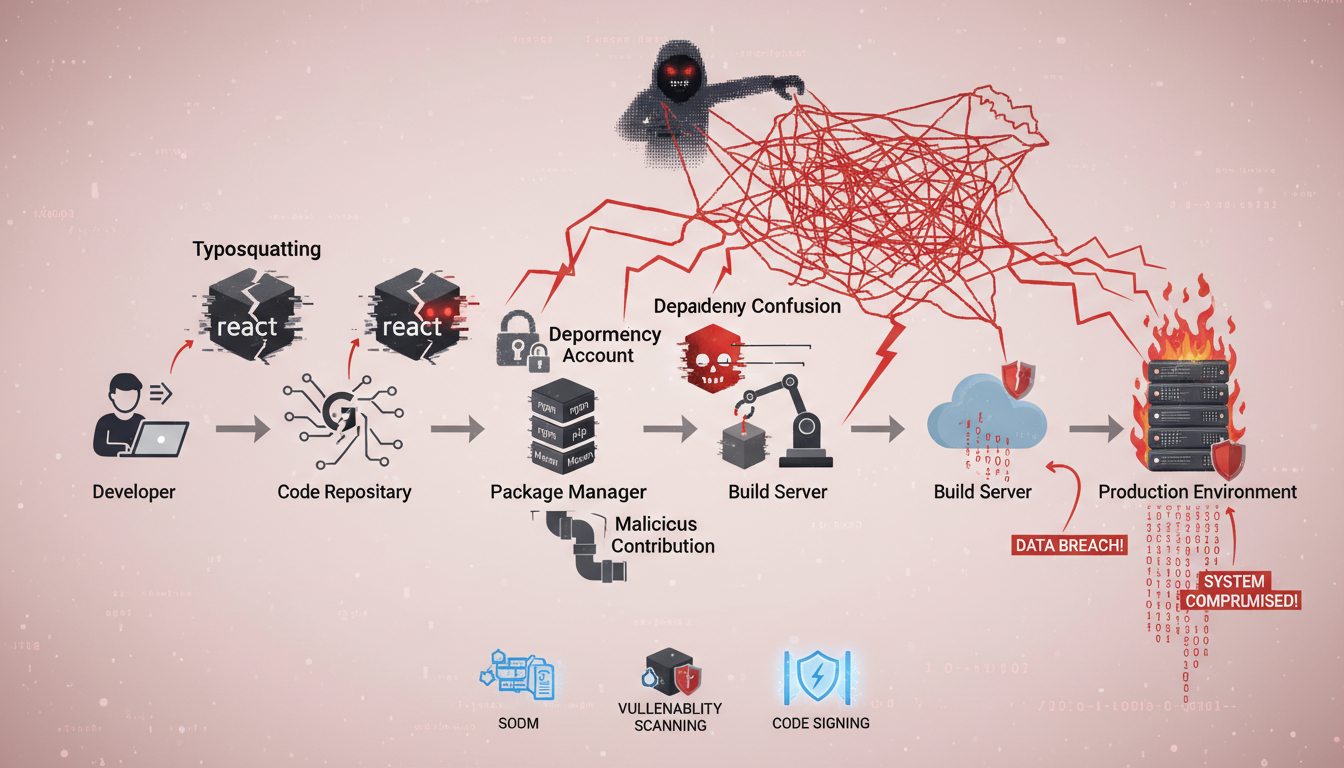
Software supply chain attacks targeting open source have sharply escalated across multiple registries, notably npm, PyPI, and extension marketplaces. In 2025, malicious package detections surged by approximately 70–75%, with npm hosting nearly 90% of these incidents. High-profile campaigns—like the self-replicating Shai-Hulud worm, the GlassWorm extensions on Open VSX, and maintainer hijacks—have weaponized trust and automation, converting dependency updates into dangerous attack vectors.
A New Chapter: Why Open Source Is in the Crosshairs
Massive Growth in Malicious Packages
Reports from ReversingLabs highlight a staggering 73% increase in detections of malicious open-source packages in 2025, up dramatically from the prior year. npm alone accounted for nearly 90% of these threats, thanks to its scale and security gaps . Sonatype’s analysis echoes this trend, noting over 1.23 million malicious packages across multiple registries and pointing to the industrialization of open source attacks .
Automating the Attack Surface
Automation and AI have accelerated both developer workflows and attacker activities. Sonatype notes that open-source downloads reached nearly 9.8 trillion, with cloud-driven build patterns amplifying risk . Attackers are increasingly weaponizing CI/CD pipelines, repository permissions, and automated dependency flows to infiltrate environments at scale.
Major Attack Campaigns That Grabbed Headlines
The Self-Replicating Shai-Hulud Worm
In September 2025, Shai-Hulud made history as the first registry-native worm in the open source world. It compromised nearly 1,000 npm packages, targeting millions of downloads to harvest tokens and credentials and self-propagate through CI/CD workflows . A second wave in November—“Shai-Hulud 2.0”—exfiltrated secrets via preinstall scripts embedded in widely used packages from Zapier, PostHog, ENS, and Postman . By late 2025, the worm had infiltrated over 700 npm packages and nearly 19,000 GitHub repositories .
Hijacked Mantainers & Phishing Attacks
Malicious actors gained control of accounts belonging to respected npm maintainers like “~qix,” distributing infected versions of widely used packages like Chalk and Debug—some cumulatively downloaded billions of times weekly . These hijacks emphasized how human compromise, not technical complexity, remains a potent vector in supply chain attacks.
GlassWorm Strikes Open VSX
In early 2026, the Open VSX extension registry suffered a breach when four previously benign macOS-targeted extensions were updated to include credential-stealing GlassWorm malware. Collectively, these extensions had garnered over 22,000 downloads before removal. The malware targeted browser credentials, crypto wallets, keychains, and dev secrets .
Broader Context: PyPI and the XZ Utils Incident
Earlier supply chain attacks underscore the ecosystem-wide risk. In late 2024, PyPI was compromised with packages deploying JarkaStealer, leveraging AI-enabled impersonation tactics . The XZ Utils backdoor, discovered in March 2024, injected a high-severity (CVSS 10.0) remote code execution payload into a critical Linux compression tool—an incident that resonates in discussions around stealth and trust in open source .
Why Open Source Is So Vulnerable, Now More Than Ever
Trust, Automation, and Scale—A Dangerous Cocktail
The open source model’s reliance on shared trust, widespread automation, and vast scale is exactly what attackers exploit. Many organizations treat dependencies as benign, which allows malware to spread silently via trusted paths .
Registry-Specific Weaknesses
npm’s slower adoption of security controls, expansive registry, and dominant presence in modern development make it a prime target. Its dependency chaining and permissive access controls provide fertile ground for malicious operations .
Human Elements in the Chain
Attackers often exploit human error—phishing, poor MFA, weak credentials. Hijacking maintainers’ accounts or abusing multi-purpose tokens have proven especially successful tactics .
Invisible, Stealth-First Attacks
Emerging malware such as Shai-Hulud and backdoors like XZ Utils operate with high stealth, embedding payloads that evade static scanning and initiate infection only upon installation .
Emerging Defenses and Research Insights
Continuous Guardrails and Verified Trust
ReversingLabs points to the need for continuous monitoring, reproducible builds, and verified trust chains covering both human and automated contributors . Sonatype underscores the role of AI-aware enforcement controls embedded directly into developer workflows .
LLM-Powered Code Regeneration: Lexo
Lexo is a novel approach that automatically regenerates safe versions of suspicious code using input-output modeling. It has proven effective in eliminating stealthy malicious behavior when evaluated across real-world package incidents .
Proactive Detection via Dynamic Datasets
The QUT-DV25 dataset enables dynamic analysis of PyPI packages, capturing install-time behaviors like network activity and system calls. It identified malicious behavior in otherwise benign-looking packages, showcasing the value of runtime detection .
Audit Frameworks for Stealthy Backdoors
A proposed LLM-based quantitative framework evaluates high-stealth backdoor risks in OSS by modeling attacker behavior across repository activity and maintenance dynamics—helping prioritize critical packages for deeper review .
Conclusion
The escalation of software supply chain attacks across the open source ecosystem is undeniable—ranging from the registry-native, self-replicating Shai‑Hulud worm and targeted maintainer hijacks to stealth malware hidden inside trusted dependencies. The sheer scale of downloads, intertwined with automation and developer trust, makes open source both essential and perilously vulnerable.
To counter this, organizations must shift from reactive detection to proactive defense: continuous monitoring, reproducible builds, enforced trust chains, dynamic behavioral analysis, and advanced code synthesis techniques. The ecosystem needs a new trust model—one that matches the rapid pace of development with equally robust and intelligent security.
FAQs
Q: What makes npm particularly vulnerable to supply chain attacks?
npm’s sheer size, dependency chaining, and slower adoption of security measures make it an attractive target. Automated propagation via CI/CD and registry-native worms such as Shai‑Hulud have amplified its risk profile.
Q: How did the Shai‑Hulud worm operate?
Shai‑Hulud compromised maintainer credentials, injected malicious payloads, and autonomously republished across packages—spreading like a worm and harvesting secrets via GitHub Actions and preinstall scripts.
Q: Can dynamic analysis help detect such supply chain attacks?
Yes. Datasets like QUT‑DV25 monitor runtime behaviors such as network calls and system access patterns, enabling detection of stealthy payloads that evade static scanning.
Q: What role can AI or LLM tools play in defense?
LLM-based tools like Lexo can regenerate clean, behaviorally equivalent code free of hidden malware. AI also aids in smart monitoring and risk assessment during development workflows.
Q: Are certain registries safer than others?
Risk varies across ecosystems. npm has seen the most aggressive attacks recently. Others—like PyPI or Maven—still pose risk but may benefit from stronger community oversight or less automation, though threat evolution continues.
Q: What immediate steps should developers take to reduce risks?
Start by enabling MFA, regularly rotating tokens, disabling auto-install scripts in CI, auditing dependencies, and adopting reproducible builds and dependency verification tools.