
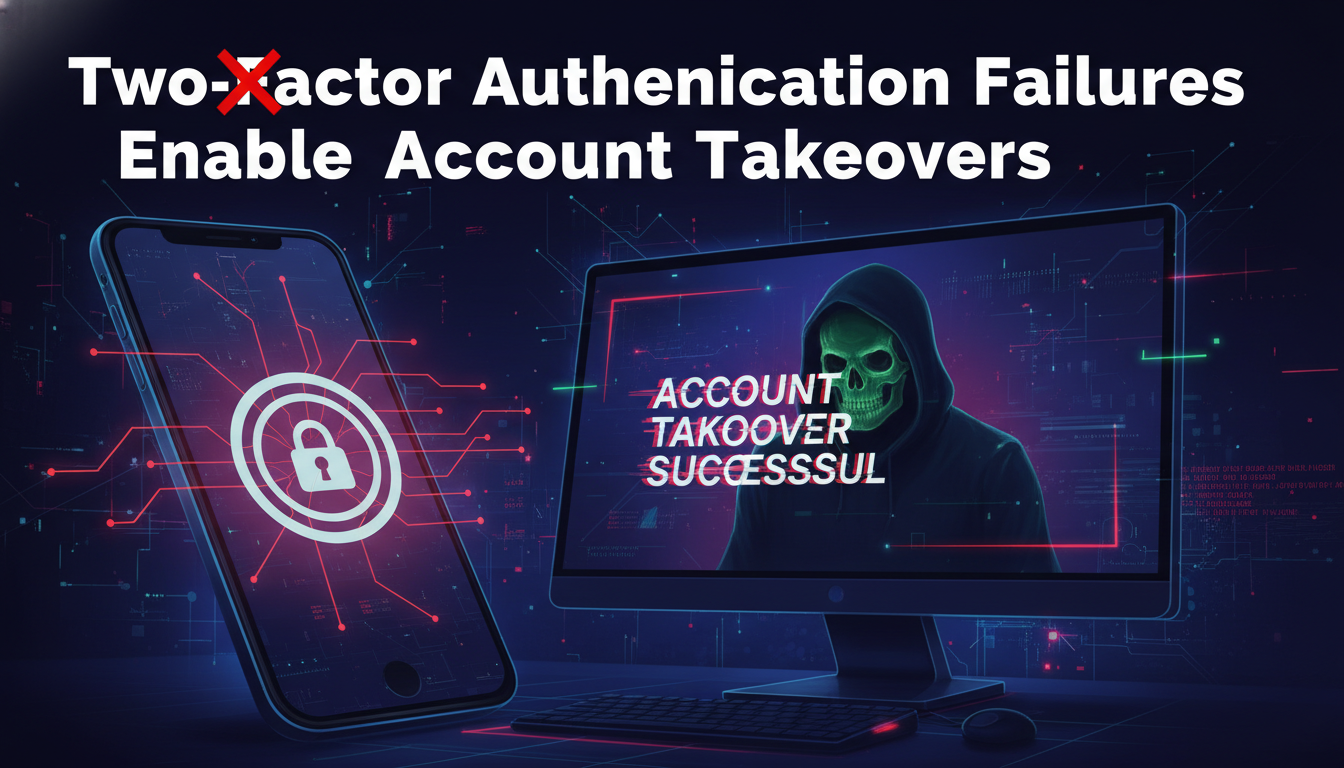
Two‑factor authentication (2FA) failures can directly enable account takeovers by compromising the second security layer meant to protect accounts, often through SMS interception, phishing of one-time codes, or misconfigurations—making otherwise secure accounts vulnerable to attackers. Let me walk you through the messy reality below.
Why 2FA Still Fails Sometimes
2FA is meant to add an extra step to access accounts, but in practice, it’s not foolproof. Recently, several high‑profile breaches hinged on failures in how 2FA is implemented or used. For example, SMS‑based codes can be intercepted via SIM swapping, and phishing attacks have gotten clever enough to capture live codes. Meanwhile, some systems allow backup codes or skip 2FA under certain conditions, creating holes.
In the end, even though 2FA adds a layer, human error, technical shortcuts, and evolving attacker strategies can erode its effectiveness. Let’s dig into the common failure modes, layered by how they happen and how attackers exploit them.
Common Weak Points in Two‑Factor Authentication
SMS and Phone‑Based Vulnerabilities
SMS‑based authentication is notorious for its security gaps. SIM swapping remains a staple for attackers: they convince carriers to reassign a number and then receive SMS codes meant for victims. Beyond that, SMS messages may be intercepted via malware or insecure cellular networks.
Even more, if carriers allow weak verification to transfer numbers, 2FA becomes superficial rather than secure. And when people lose phones, backup codes may be used carelessly, sometimes stored in plain text.
Phishing, Social Engineering, and Fake Login Sites
Attackers have refined phishing to the point of real-time interception. Victims enter credentials and then one-time codes into fake sites, which relay them to real services immediately. The window of opportunity is tiny, but if attackers act quickly, they can capture a full session.
Social engineering also helps on the other end: convincing help desks to disable 2FA temporarily, or transferring codes over chat. It’s a messy trickery that turns security features against themselves.
“The biggest mistake is assuming two‑factor equals two‑factor when it’s really just one factor plus a speed bump.”
That captures the reality: 2FA slows attackers, but doesn’t always stop them.
Back‑Up Options and Recovery Loopholes
Most systems offer recovery options—backup codes, email resets, security questions. If those are weak or stored insecurely, attackers can bypass 2FA altogether. Worse, users often write down backup codes or answer easy questions, undercutting the principle of a second, independent factor.
And on the administrative side, some systems allow session persistence or “remember my device,” which creates long‑lived trust that attackers can abuse.
Misconfigurations and Developer Oversights
Developers sometimes implement 2FA poorly. For example, failing to enforce 2FA across all endpoints, or not validating flags when sessions are escalated. Some vulnerable APIs let users bypass 2FA checks, or rely on deprecated libraries with known exploits.
In other cases, rollout is partial—only for login screens and not for password resets or critical actions. The mismatch leaves gaps. It’s a patchwork in practice, not the airtight barrier we hope.
Real‑World Examples and Lessons Learned
Case Study: A SIM Swap Gone Wrong
A well‑known tech executive recently lost control of a social media account because attackers intercepted SMS codes via a SIM swap. Despite having 2FA enabled, the attacker reset the account’s password and took over. It was a painful reminder: a single-factor vulnerability (the phone number) can nullify a second factor.
Phishing at Scale: Enterprise Breach Scenario
Another scenario involved an organization whose employees fell for targeted phishing. Attackers sent emails mimicking internal IT messages, prompted employees to re-enter login credentials and MFA codes, and used those to break in. The breach led to data exfiltration. The organization realized too late their 2FA provider didn’t support phishing-resistant methods.
Developer Mistake: Incomplete Enforcement
A smaller fintech platform launched 2FA but forgot to apply it to critical API endpoints. Developers tested with their own accounts and assumed everything was covered—but attackers found the open endpoint and bypassed 2FA entirely. It’s a classic case of “we tested login, but forgot edge cases.”
Strengthening Two‑Factor Authentication: Beyond the Basics
Prefer Phishing‑Resistant Methods
Security keys (e.g., FIDO2, WebAuthn) or authenticator apps provide stronger protection than SMS or email-based codes. They’re not eroded by SIM swaps or network interception. Encouraging—or even requiring—these methods can vastly reduce takeover risk.
Stricter Recovery and Backup Protocols
Limit backup codes: provide a small number, make them single-use, require secure storage (like password managers). Let users regenerate them—but invalidate old codes immediately. As for security questions or email resets, make them strong or eliminate them entirely.
Enforce 2FA Everywhere
Make 2FA mandatory for login, password resets, sensitive actions, and administrative changes. Ensure APIs and session tokens validate 2FA status. Audit your system as if attackers are actively searching for ways around.
Educate Users and Admins
Humans are the weakest link. Teach users about SIM‑swap scams, phishing red flags, and secure code storage. Admins should understand their own recovery procedures and not override 2FA casually.
Use Conditional Access and Anomaly Detection
Implement risk-based analysis—flag logins from new devices, locations, or VPNs. Force re-authentication with 2FA if anything seems odd. These additional layers help catch misuse before it leads to a full takeover.
Feasibility vs. Friction: Balancing Usability with Security
Adding strong 2FA can inconvenience users. The trick is to strike a balance:
- Use step-up authentication for risky logins rather than blanket requirements.
- Provide easy but secure recovery paths (like hardware key-based backup).
- Communicate clearly: make users understand why extra steps matter.
Security isn’t about maximum friction—it’s about smart friction.
Conclusion
Two‑factor authentication failures often enable account takeovers because attackers exploit weak second factors, slick phishing, recovery paths, or implementation flaws. The fix? Move to phishing-resistant methods, tighten recovery, cover all access points, train users, and layer risk-based checks. In short: don’t treat 2FA as paint—it’s part of the structure.
FAQs
Why do SMS‑based 2FA methods often fail?
SMS codes can be intercepted through SIM swapping, malware, or insecure networks, making them vulnerable compared to more robust authentication methods.
Can phishing attack 2FA codes?
Yes. Sophisticated phishing can capture live 2FA codes by tricking users into entering them on fake login pages, relaying them instantly to attackers.
Are backup codes risky?
They can be, if stored improperly or left unused. Keeping them secure in password managers and limiting their issuance reduces risk significantly.
Is requiring 2FA on APIs necessary?
Absolutely—attackers target overlooked endpoints. Enforcing 2FA across APIs, logins, resets, and sessions closes common bypass routes.
How do hardware keys improve 2FA?
Hardware keys like FIDO2 are phishing-resistant and tied to physical devices, making them much harder to intercept or misuse than SMS or email codes.
How can organizations balance 2FA security and user convenience?
Use adaptive authentication: challenge users only when risk factors are present, offer clear communication, and provide secure but accessible recovery options for legitimate users.